
Saudi Arabia Scholarships 2026: King Abdullah Program & Public University Grants for International Students
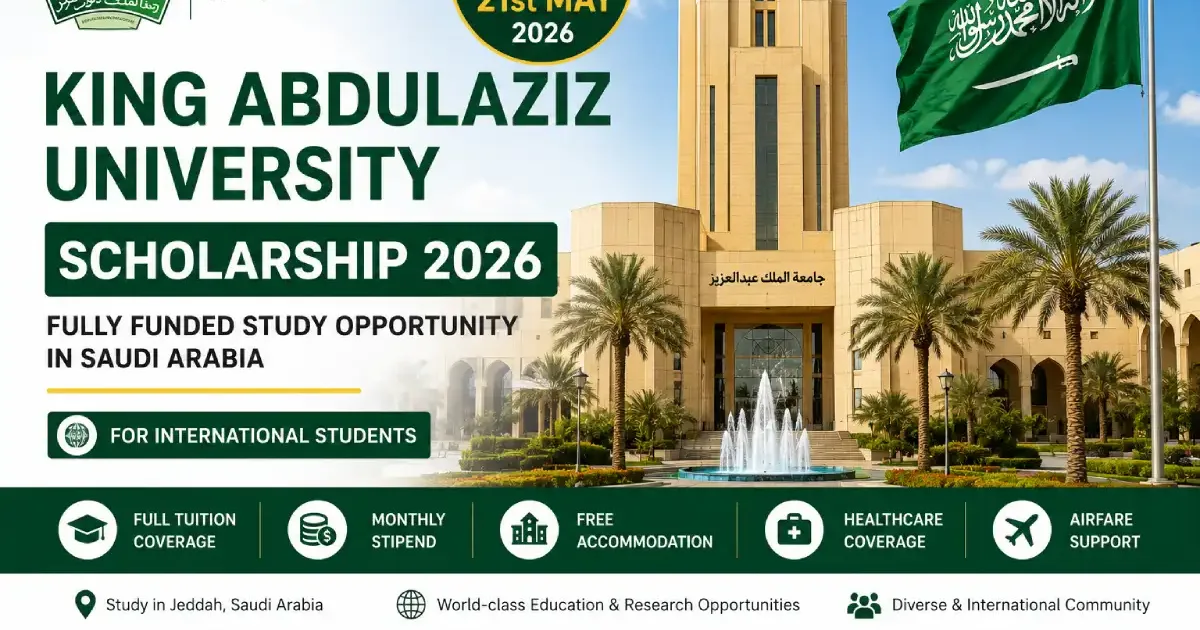
Saudi Arabia runs two main scholarship tracks: the Custodian of the Two Holy Mosques Scholarship Program sends Saudi citizens to top universities abroad, while Saudi public universities host international students from more than 200 countries across 27 government campuses. The first targets high-school and university graduates who hold unconditional offers from world-leading institutions; the second attracts high-achieving non-Saudis for diploma, bachelor's, master's and doctoral studies.
What Is the Custodian of the Two Holy Mosques Scholarship Program?
A government initiative that places Saudi students in the world's highest-ranked institutions to upgrade human capital, strengthen research, development, innovation and entrepreneurship, and deliver on Saudi Vision 2030 goals (source). Eligible applicants are secondary-school graduates, university graduates, or holders of unconditional offers from top global universities (source).
What Are the Four Scholarship Tracks and How Do They Differ?
The program comprises four tracks, each with a distinct objective, target university tier and academic level (source) (source):
| Track | Objective | Target Institutions | Levels / Fields |
|---|---|---|---|
| Pioneers (Al-Rawad) | Place students in the world's best institutions across all disciplines | Top 30 global institutions | Bachelor's and master's, all majors |
| Research & Development | Build R&D capacity in strategic sectors | Top 200 globally in priority fields | Priority R&D disciplines |
| Supply (Imdad) | Fill high-demand labour-market specialisations | Top 200 universities and institutes worldwide | Bachelor's or master's in specified fields |
| Promising (Wa'ad) | Study, training and reskilling in emerging sectors | Per announced partnership programmes | "Employment-linked scholarship" programmes with partner entities |
How Does the Wa'ad Track and "Employment-Linked Scholarship" Work?
The Wa'ad track is the most frequently advertised; it rolls out "employment-linked scholarship" programmes in partnership with specific entities. Each programme has its own duration, destination country, training institution and application window — sometimes only a few days (source). Recurring eligibility criteria across Wa'ad announcements:
- Saudi national of good conduct.
- Full-time study and residence in the host country.
- Pass the partner entity's specific selection policies and standards.
- Not currently on an active scholarship, though current scholars may apply.
- Qualification, GPA and English-language score set by each programme; foreign credentials must be equivalenced by the competent authority.
Example: a master's in Sports Event and Venue Management required a bachelor's GPA of at least 2.5/4.0 or 3.0/5.0 and IELTS 6.0 (source).
What Are the General Eligibility Rules for the Ministry of Education Scholarship Service?
The Ministry of Education's "External Scholarship Request" service for Saudi students requires (source):
- Final, unconditional university admission.
- Scholarship covers full tuition through graduation.
- University listed on the Ministry's recommended-institutions list.
- Major falls within the specialisations approved by royal orders.
- Major matches or extends the previous qualification.
- Destination country is on the Ministry's approved list.
- Age limits: 30 for bachelor's, 35 for master's, 45 for doctorate.
- Compliance with general external-scholarship regulations.
Application steps: log into the Safir portal at ksp.moe.gov.sa, select the academic level, and complete the form (source). Expected processing time: five working days.
What Scholarships Do Saudi Public Universities Offer International Students?
The Kingdom awards grants to attract outstanding international students to 27 public universities nationwide; enrolled nationalities exceed 200 (source). Two categories exist:
- Internal scholarships: for non-Saudi residents legally residing in the Kingdom, conditional on sponsor approval.
- External scholarships: for non-Saudis abroad; these may be fully funded (all benefits), partially funded (seat only, or seat plus housing), or self-funded, per each university's rules.
Levels covered: Arabic-language diploma for non-native speakers, bachelor's, higher diploma, master's and doctorate. Health and medical specialisations are excluded from application (source).
What Are the Detailed Requirements for International Students (Islamic University Example)?
General Saudi admission rules apply, plus additional controls for full and partial grants (source):
- Secondary-school certificate or equivalent (scientific stream for scientific colleges), obtained within the last five years.
- Age 17–25 for undergraduate and language institute; up to 30 for master's; up to 35 for doctorate.
- Good conduct, not dismissed disciplinarily, not holding another Saudi scholarship.
- Police clearance certificate from the applicant's home country.
- Academic or institutional reference from a recognised body or scholar in the home country.
- Medical fitness and passing any university-announced tests or interviews.
- Pledge to abide by Saudi and university regulations.
- For partial (internal) grants: employer's consent to study.
- Weighted-admission formula: theoretical colleges — secondary 50% + aptitude 50%; scientific colleges — secondary 30% + aptitude 30% + achievement 40%.
How Does an International Student Apply?
- Choose a public university and review its requirements and available majors.
- Apply during the admission window via the "Study in Saudi Arabia" platform (source).
- From abroad: applications can also be submitted through the Saudi cultural attaché in the applicant's country, or the Saudi embassy where no attaché exists.
- After award, obtain a student visa from the Saudi embassy; upon arrival, a free student residence permit is issued based on the university's letter.
Sample Application Dates (Islamic University 1448 AH)
Islamic University application period: 2-11-1447 AH (19 April 2026) to 4-12-1447 AH (21 May 2026) via the "Study in Saudi Arabia" platform (source). Deadlines vary by university; check the target university's website or the platform when admissions open.
Key Figures at a Glance
- Custodian of the Two Holy Mosques Scholarship tracks: 4 (source: programme site)
- Pioneers track — target institutions: Top 30 globally (source: programme site)
- R&D and Supply tracks — target institutions: Top 200 globally (source: programme site)
- Saudi public universities hosting grants: 27 (source: Ministry of Education)
- Nationalities represented in Saudi universities: More than 200 (source: Ministry of Education)
- Age ceiling for Saudi bachelor's scholarship: 30 years (source: Ministry of Education)
- Age ceiling for international bachelor's grant: 25 years (source: Islamic University)
- External scholarship request processing time: Five working days (source: Ministry of Education)
Bottom Line and What to Watch
If you are Saudi and aim for a top-30 or top-200 global university, pick your track (Pioneers, R&D, Supply, Wa'ad) based on your major and the tier of the university that admitted you, then apply via the Safir portal (ksp.moe.gov.sa) while observing age caps and track-specific rules. Monitor Wa'ad announcements regularly for employment-linked programmes with short application windows.
If you are an international student, select the right public university from the 27, confirm you meet the criteria (age, non-medical major, weighted score, reference, police clearance), and apply through the "Study in Saudi Arabia" platform during each university's admission period. Consult the Ministry of Education's grant page and the platform for updated major lists and announcements.