
Saudi Health Data Protection Law: Hospital Duties and Patient Rights (2026 Guide)
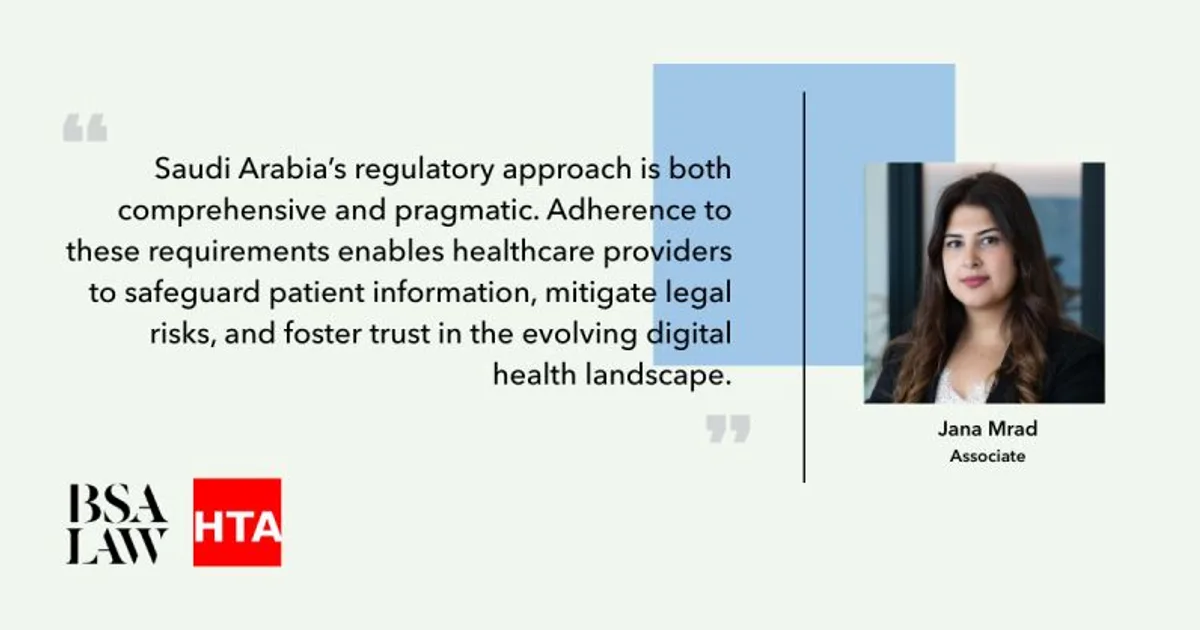
Health data in Saudi Arabia is classified as "sensitive data" under the Personal Data Protection Law, requiring hospitals and clinics to limit access, document every processing stage, and report any breach within 72 hours of discovery. The Saudi Data and AI Authority (SDAIA) oversees enforcement, while the Ministry of Health applies compliant privacy policies across its portal and e-services.
What is the Personal Data Protection Law and when did it take effect?
The law was issued by Royal Decree No. (M/19) dated 09/02/1443H and amended by Royal Decree No. (M/148) dated 5/9/1444H. The law and its implementing regulations entered force on 29/2/1445H, corresponding to September 14, 2023, granting entities a period not exceeding one year to regularize their status. Implementation is overseen by the Saudi Data and AI Authority (SDAIA).
What counts as health data under the Saudi law?
The law defines health data as any personal data relating to an individual's health condition — physical, mental, or psychological — or to the health services provided to them. This covers diagnoses, lab results, prescriptions, visit records, and insurance claims. The law places health data in the "sensitive data" category alongside ethnic origin, religious, intellectual or political beliefs, security and criminal data, biometric data, and genetic data.
What obligations do hospitals and clinics (controllers) have toward health data?
Article 23 of the law requires controllers to apply additional safeguards when processing health data. Article 26 of the implementing regulations details these safeguards, requiring a health facility to:
- Adopt organizational, technical, functional, and administrative measures that protect health data from unauthorized use or disclosure.
- Distribute tasks and responsibilities among staff to prevent role overlap and diffused accountability.
- Observe hierarchical access levels (least privilege for least need).
- Document all health data processing stages, with the ability to identify the person responsible for each stage.
- Include in contracts with processors (such as cloud providers) a commitment to these measures.
The law's fundamental processing principles also bind controllers to lawfulness, fairness, transparency, purpose limitation, data minimization, disposal after the purpose ends, and protection during transfer.
What is the breach notification deadline and who must be notified?
Article 20 of the law obliges the controller to notify the competent authority (SDAIA) immediately upon becoming aware of a breach, damage, or unlawful access. Article 24 of the implementing regulations sets the deadline at 72 hours from awareness of the incident. Data subjects (patients) must also be notified if the breach is likely to cause them harm. Every health facility therefore needs a pre-designated team that knows who detects the incident, who assesses impact, and who sends the notification, so the window is not lost searching for the responsible person.
What rights does a patient have over their health data?
Article 4 of the law grants data subjects clear rights, and the Ministry of Health privacy policy affirms these rights on its portal:
- Right to be informed: Know the purpose and legal basis for collection, the identity of the collecting entity, the recipients of the data, whether it will be transferred outside the Kingdom, and the consequences of non-completion.
- Right of access: Request a copy of personal data held by the controller in a readable, clear format.
- Right to rectification: Request correction or completion of data.
- Right to erasure: Request erasure of data no longer needed, as permitted by the law.
The Ministry of Health policy states that data sharing occurs only for legitimate purposes, with identities masked before use in analytics.
What penalties apply for violating health data protection?
| Violation | Penalty under the law |
|---|---|
| Disclosure or publication of sensitive data with intent to harm or for personal gain | Imprisonment up to two years and a fine up to 3 million riyals, or either penalty |
| Other violations of the law or regulations | Warning or fine up to 5 million riyals |
| Repeat violation | Doubling the fine, not exceeding 10 million riyals |
Key figures
- Effective date: September 14, 2023 (29/2/1445H) — Ministry of Health privacy policy
- Breach notification window: 72 hours from awareness — implementing regulations
- Maximum fine for serious violation: 3 million riyals + imprisonment up to two years — Personal Data Protection Law
- Maximum fine for other violations: 5 million riyals (up to 10 million for repeat offenses) — the law
- Regularization period for entities: one year from effective date — the law
Takeaways and what to watch
As a patient: preserve your right to request a copy of your medical record, correct its contents, and know who accessed it. Follow updates to SDAIA policies and its data breach incident guide.
As a health facility: review cloud provider contracts to embed Article 26 commitments, train your response team on the 72-hour scenario, and document hierarchical access permissions. Monitor SDAIA releases for binding common controls and the processing activity logs guide.