
Saudi Geothermal Energy 2026: From Exploration to District Cooling
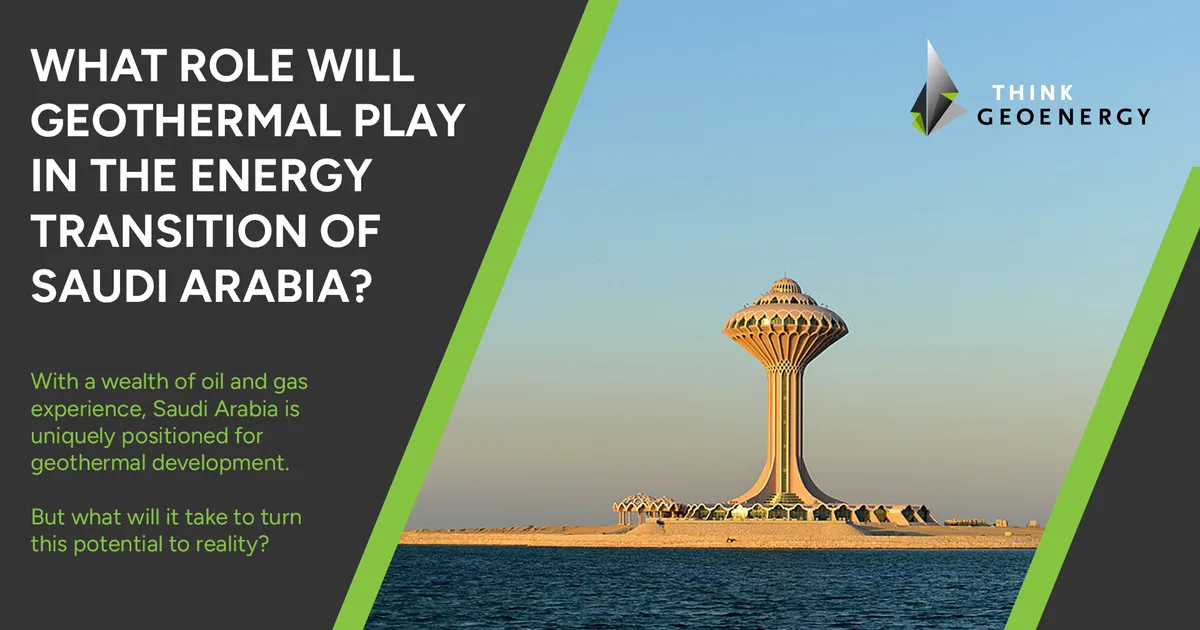
As of November 2026, Saudi Arabia has no commercial geothermal power plant generating electricity. The sector remains in the exploration and research phase, with practical focus on geothermal cooling applications that target air-conditioning demand — the kingdom's single largest electricity load. (Source: ACWA Power closes financing for 7 Saudi energy projects worth 22.3 billion riyals | Al-Eqtisadiah)
What is geothermal energy and why does it matter to Saudi Arabia?
Geothermal energy is heat from the Earth's interior, exploited in two main ways: electricity generation where temperatures are high enough to drive a turbine, and heating and cooling via heat exchange with the ground at shallow depths where temperatures stay relatively stable year-round. For Saudi Arabia, the relevance lies in cooling: residential air-conditioning consumes about 101 terawatt-hours annually, commercial buildings about 70 terawatt-hours, and cooling can reach nearly 70% of peak electricity use, according to a March 2025 ThinkGeoEnergy report. Specialists therefore see the nearest practical benefit in cutting the cooling bill before pursuing power generation. (Source: Saudi-US alliance to execute projects worth 3 billion riyals in Saudi Arabia | Al-Eqtisadiah)
Where are the geothermal resources in the kingdom?
Resources are concentrated in three geological zones: (Source: Al-Baha tourism projects raise hotel capacity to 1,370 rooms by 2029 | Al-Eqtisadiah)
- Western volcanic harrats: More than 2,500 dormant volcanoes, hot springs reaching around 80°C, with exploration underway at Harrat Rahat.
- Jazan region in the south: Characterized by a geothermal gradient far above average, meaning temperature rises much faster with depth.
- Arabian Platform in the east: Sedimentary formations holding oil and gas, some wells reaching exploitable temperatures, with the concept of repurposing old oil and gas wells.
The kingdom's overall geothermal gradient is described as low to medium, implying that power generation would require deep drilling and costly studies before any investment decision.
What is KAUST doing in geothermal energy?
In early 2024, a research well was drilled inside the King Abdullah University of Science and Technology (KAUST) campus to a depth of roughly 400 meters, in partnership with TAQA Geothermal. The well's purpose is reconnaissance, monitoring, and technology testing — not production. The university hosts the Geothermal Energy and Mineral Resources Platform on a 3,200-square-meter site; among its research axes are Enhanced Geothermal Systems (EGS) to study fluid-rock fracture interaction for extracting heat from naturally impermeable rock.
Which companies are active in Saudi geothermal?
TAQA Geothermal: A joint venture formed in 2023 between Saudi TAQA and Iceland's Reykjavik Geothermal, headed by executive Mishari Al-Ayed. On February 14, 2025, it signed a memorandum of understanding with EDF Saudi Arabia during the Private Sector Forum organized by the Public Investment Fund in Riyadh, covering three areas: geothermal power generation, cooling applications, and compressed-air energy storage.
Stratafi: A startup operating in geothermal cooling under a "cooling-as-a-service" model. In April 2025 it announced it had drilled more than 25 shallow wells for cooling applications.
How does geothermal link to Vision 2030?
The official Vision 2030 target is for renewables to reach 50% of the electricity mix by 2030, displacing roughly one million barrels per day of liquid fuel used in generation. That plan currently rests on solar and wind. Geothermal does not appear in the sources as a standalone numerical target; the companies involved present it as a renewable baseload source that can complement solar and wind because it operates day and night.
Key documented figures
- Residential cooling consumption: 101 terawatt-hours/year (ThinkGeoEnergy report, March 2025)
- Commercial cooling consumption: 70 terawatt-hours/year (same source)
- Cooling share of peak electricity: nearly 70% (same source)
- KAUST research well depth: ~400 meters (early 2024)
- KAUST platform area: 3,200 square meters
- Stratafi wells drilled: more than 25 wells (April 2025)
Bottom line and what to watch
The practical track today is geothermal cooling for buildings — a mature, immediately scalable technology that directly cuts air-conditioning demand. Power generation remains in exploration and studies, with a single research well at KAUST and non-binding MoUs. Watch for: KAUST well results, conversion of MoUs into EPC contracts, announcement of any government tender for a commercial geothermal project, and deployment progress by TAQA Geothermal and Stratafi in cooling-as-a-service.