
Saudi REITs: How Traded Real Estate Funds Acquire Commercial and Industrial Assets
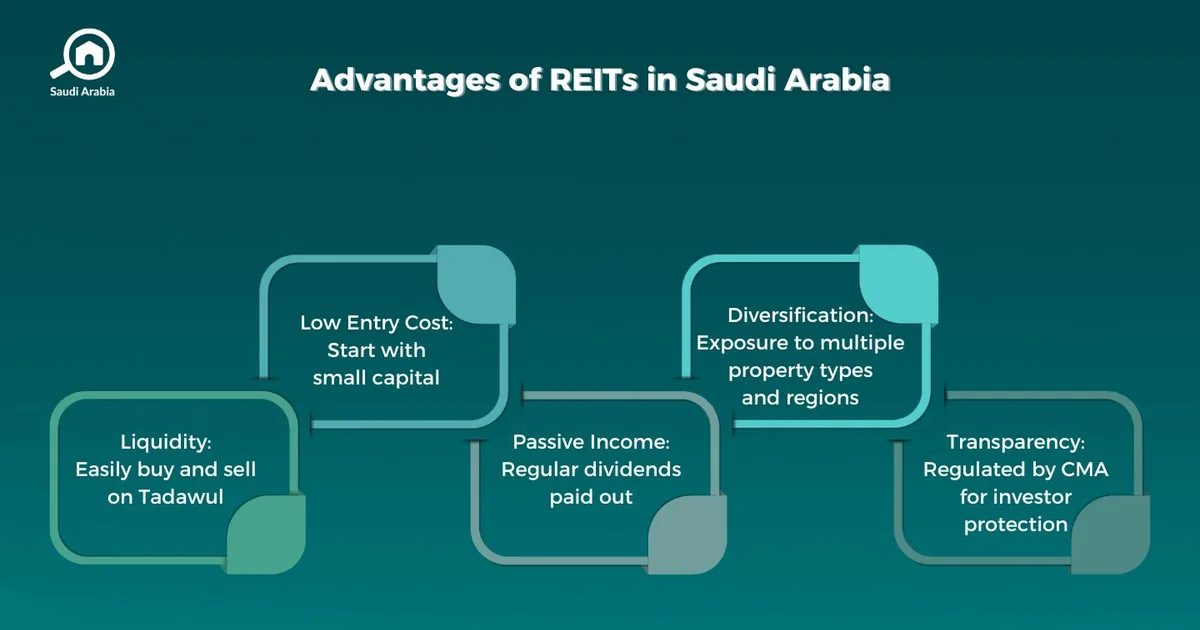
Amid global economic volatility affecting financial and real estate markets in 2026, Real Estate Investment Trusts (REITs) in the Saudi market are emerging as a safe haven for investors seeking stable returns. Data released by the Capital Market Authority (Saudi Stock Exchange - Tadawul) indicates that the asset size of Saudi REITs grew by 35% over the past two years, reaching over 45 billion Saudi riyals, at a time when global markets are experiencing a 15% decline in the commercial real estate sector due to rising interest rates.
Saudi REITs are increasingly targeting commercial and industrial assets, benefiting from structural shifts in the Saudi economy under Vision 2030, with these assets now constituting 60% of their investment portfolios, compared to 40% five years ago. This shift comes amid unique investment opportunities offered by privatization and localization programs, particularly in sectors such as logistics warehouses, shopping centers, and industrial complexes, with demand for industrial space expected to grow by 25% by 2030.
What are Real Estate Investment Trusts (REITs) and how do they operate in the Saudi market?
Real Estate Investment Trusts (REITs) are investment instruments that pool investor funds to own and manage a portfolio of income-generating real estate, distributing most of their profits to shareholders periodically. In the Saudi market, these funds are regulated by the Capital Market Authority (CMA), which requires that at least 75% of their assets be invested in income-generating real estate and that 90% of net income be distributed to investors.
Saudi REITs began operations in 2016 with the launch of the Jabal Omar Fund, and since then, they have expanded to include 22 funds traded on the Saudi Stock Exchange (Tadawul) by 2026, with total assets exceeding 45 billion riyals. These funds operate within an advanced regulatory framework that includes transparency and disclosure requirements, with quarterly reports on their financial performance and real estate portfolio components.
Saudi REITs are characterized by their geographic focus within the Kingdom, with major investments in cities such as Riyadh, Jeddah, and Dammam, which account for 80% of total fund investments. Their investments also diversify across sectors, with an increasing focus on commercial assets (shopping malls, offices) and industrial assets (warehouses, factories) that are experiencing growing demand due to economic growth.
How do Saudi REITs benefit from global volatility in acquiring assets?
Global volatility in commercial real estate markets creates exceptional opportunities for Saudi REITs, as asset values in some global markets have fallen by 20-30% since 2024, while the Saudi market has maintained relative stability thanks to supportive local factors. These funds exploit this pricing gap to acquire high-quality assets at reasonable prices, especially in markets facing financial pressures on current owners.
The acquisition strategy relies on several key pillars: first, focusing on assets with long-term leases and tenants with high credit quality, ensuring stable cash flows. Second, investing in assets that can be developed or renovated to enhance their value over time. Third, geographic diversification within the Kingdom to mitigate risks, with a focus on areas with high population and economic growth.
Data from a Saudi real estate market research company indicates that REITs completed 15 major acquisitions of commercial and industrial assets during 2025, with a total value of 8 billion riyals, a 40% increase from 2024. Notable deals include the Al-Taameer Commercial Fund's acquisition of a commercial complex in northern Riyadh for 1.2 billion riyals, and the Al-Ahli Real Estate Fund's acquisition of logistics warehouses in King Abdullah Economic City for 900 million riyals.
Why are commercial and industrial assets attractive to REITs at present?
Commercial and industrial assets are experiencing increasing demand in the Saudi market due to structural shifts in the economy, with Vision 2030 initiatives such as the Quality of Life Program and the National Industrial Development and Logistics Program (NIDLP) driving growth. Estimates from the Ministry of Industry and Mineral Resources indicate that demand for industrial space will rise by 25% by 2030, while demand for commercial space is expected to grow by 15% annually until 2030.
Commercial and industrial assets offer higher rental yields compared to residential assets, with net yields for commercial assets ranging from 7-9%, and for industrial assets from 8-10%, compared to 5-6% for residential assets. Additionally, lease contracts in these sectors are typically longer-term (3-10 years) and include clauses that protect owners from inflation, providing more stable cash flows for the funds.
The Saudi government supports this trend through initiatives such as the privatization program, which opens opportunities for funds to acquire government assets, and economic city projects like NEOM and King Abdullah Economic City, which offer new investment opportunities. Moreover, the expansion of the e-commerce sector increases demand for logistics warehouses, with estimates from the General Authority for Competition indicating a 30% annual growth in e-commerce volume.
What are the risks and challenges facing REITs in current real estate investment?
Saudi REITs face several challenges in the current investment environment, most notably rising global interest rates that affect financing costs, with benchmark interest rates increasing by 3% since 2023. Volatility in rental markets also poses a challenge, especially in the office sector, which has seen a 5% decline in occupancy rates in some areas due to the shift towards hybrid work.
Other risks include potential regulatory changes, as the Capital Market Authority is updating REIT regulations to keep pace with global developments, which may impact operational and distribution requirements. Heavy reliance on the domestic economy also exposes funds to cyclical fluctuations in the Saudi market, although portfolio diversification mitigates these risks.
A study by King Saud University indicates that 65% of REIT managers consider rising operating and maintenance costs the biggest challenge, especially with inflation rates reaching 3.5% in 2025. Additionally, increasing competition from international investors redirecting investments towards emerging markets poses an additional challenge, with their share in the Saudi real estate market rising to 25% in 2025.
Will Saudi REITs continue to attract local and international investors?
Current indicators suggest that Saudi REITs will continue to attract investors, having achieved average annual returns of 8.5% over the past five years, compared to 6.2% for the general Tadawul index. Additionally, dividend distributions averaging 7% annually provide a steady income stream, enhancing their appeal for income-focused investors.
Future growth prospects are supported by Vision 2030 projects and economic diversification, with expectations that REIT assets will exceed 70 billion riyals by 2030. The entry of international investors, whose participation in Saudi REITs increased to 15% in 2025, reflects growing confidence in the market's stability and potential, positioning these funds as a key component of the Saudi investment landscape in the coming years.